

The Interior Designer's Guide to Managing Multiple Projects at Once
The moment you've been working toward — fully booked, multiple projects running simultaneously, the business finally feeling like a business — arrives. And then, about three weeks in, it also feels like controlled chaos.
Different clients at different stages. Emails from four projects stacking up in the same inbox. A site visit for Project A that clashes with a presentation for Project B. A supplier chasing on Project C while you're trying to think about the concept for Project D.
Managing one project well is a design skill. Managing four projects well simultaneously is a systems skill — and it's one that most designers have to learn the hard way, usually after dropping something important.
This guide is the shortcut. Here's how to run multiple projects without losing your mind, your quality, or your clients' trust.

Running multiple projects isn't about doing more. It's about building systems that mean nothing important ever falls through the cracks.
Start Here: Know Your Real Capacity
The root cause of most multi-project chaos isn't poor organisation — it's taking on more than your actual capacity allows. Before any system can help you, you need an honest answer to one question: how many projects can you run well at the same time?
The answer depends on your project type, your team size, and your work style. A solo designer running full-scope residential projects will have a very different capacity ceiling to someone who offers lighter-touch consultancy. But most designers, if they're honest, have overestimated their capacity at least once.
A simple capacity framework
Think about your projects not as units but as phases — because the demands on your time vary dramatically across a project's lifecycle:
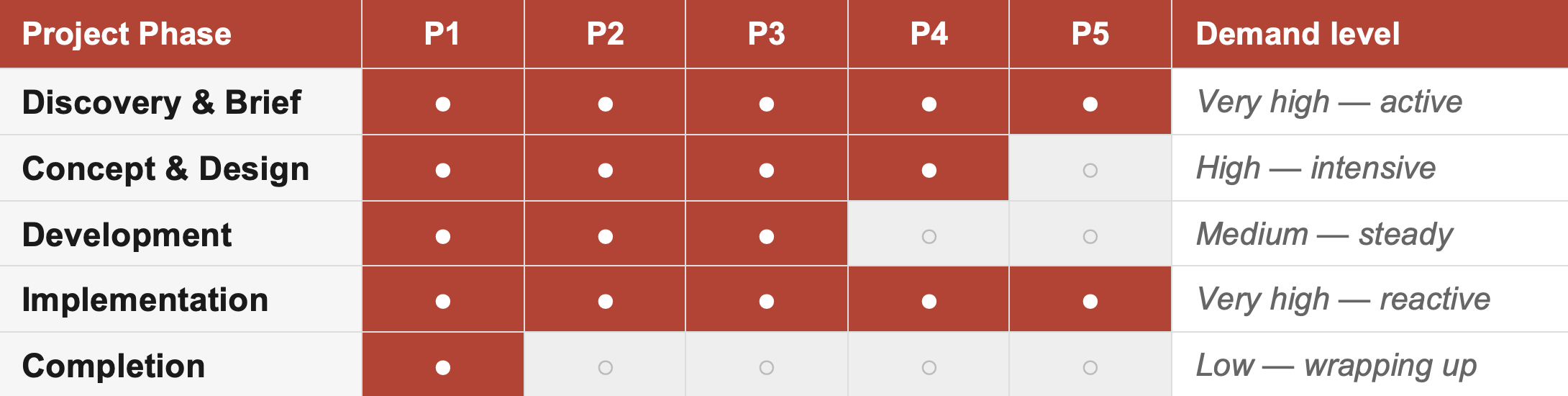
The insight here: two projects in Discovery and Implementation simultaneously is the equivalent of five in Development. Before accepting a new project, ask which phase each existing project is in — not just how many you have.
The Five Systems That Make Multi-Project Management Work
Systems don't need to be complicated or expensive. The designers who manage multiple projects smoothly aren't using bespoke software or elaborate processes — they have a small number of simple, consistent habits that prevent the most common failure modes.
📁 One Home for Every Project
What it does: A dedicated folder (digital or physical) for every active project containing the contract, brief, all correspondence, drawings, specifications, invoices, and supplier communications. Everything in one place, nothing stored in email threads alone.
Why it matters:When a client calls with a question about their project at 4pm on a Friday, you can find the answer in 30 seconds rather than 10 minutes. This alone is worth the setup time.
📋 A Weekly Project Status Review
What it does: Every Monday morning, spend 20 minutes reviewing the status of every active project. What's due this week? What's waiting on a client response? What supplier needs chasing? What decisions are pending?
Why it matters:This single habit catches problems before they become crises. A task that slips through in Week 1 can derail a project in Week 4. The weekly review makes sure nothing waits longer than seven days to be noticed.
📅 Dedicated Days by Project Type
What it does: Rather than switching between projects all day every day, designate certain days or half-days to specific projects or task types. Monday and Tuesday: Project A site work and communications. Wednesday: design development across projects. Thursday: Project B supplier sourcing. Friday: admin, invoicing, reviews.
Why it matters:Context switching between projects is expensive — it takes 15–20 minutes to fully re-enter a project's mental space each time you switch. Batching project time dramatically reduces that loss.
💬 Standardised Client Communication Cadence
What it does: Every active client should receive a project update on a predictable schedule — weekly for fast-moving phases, fortnightly for steadier ones. A brief, structured email: what happened this week, what's coming next, any decisions needed from them.
Why it matters:Proactive communication prevents the anxious client who emails daily because they haven't heard anything. It also means every client feels attended to, even when you're deep in another project.
⏰ Response Time Rules
What it does: Set clear internal rules for yourself: client emails get a response (even if just an acknowledgement) within 24 hours on working days. Supplier queries within 48 hours. Anything needing a site visit gets scheduled within a week of the request.
Why it matters:Without these rules, urgent and non-urgent tasks compete on equal footing and everything feels like an emergency. With them, your clients feel prioritised and you retain control of your time.
The Weekly Rhythm That Keeps Everything Moving
Here's what a structured week looks like for a designer running three to four projects simultaneously. Adapt it to your own working patterns — the point isn't the specific schedule, it's the principle of intentional time allocation.
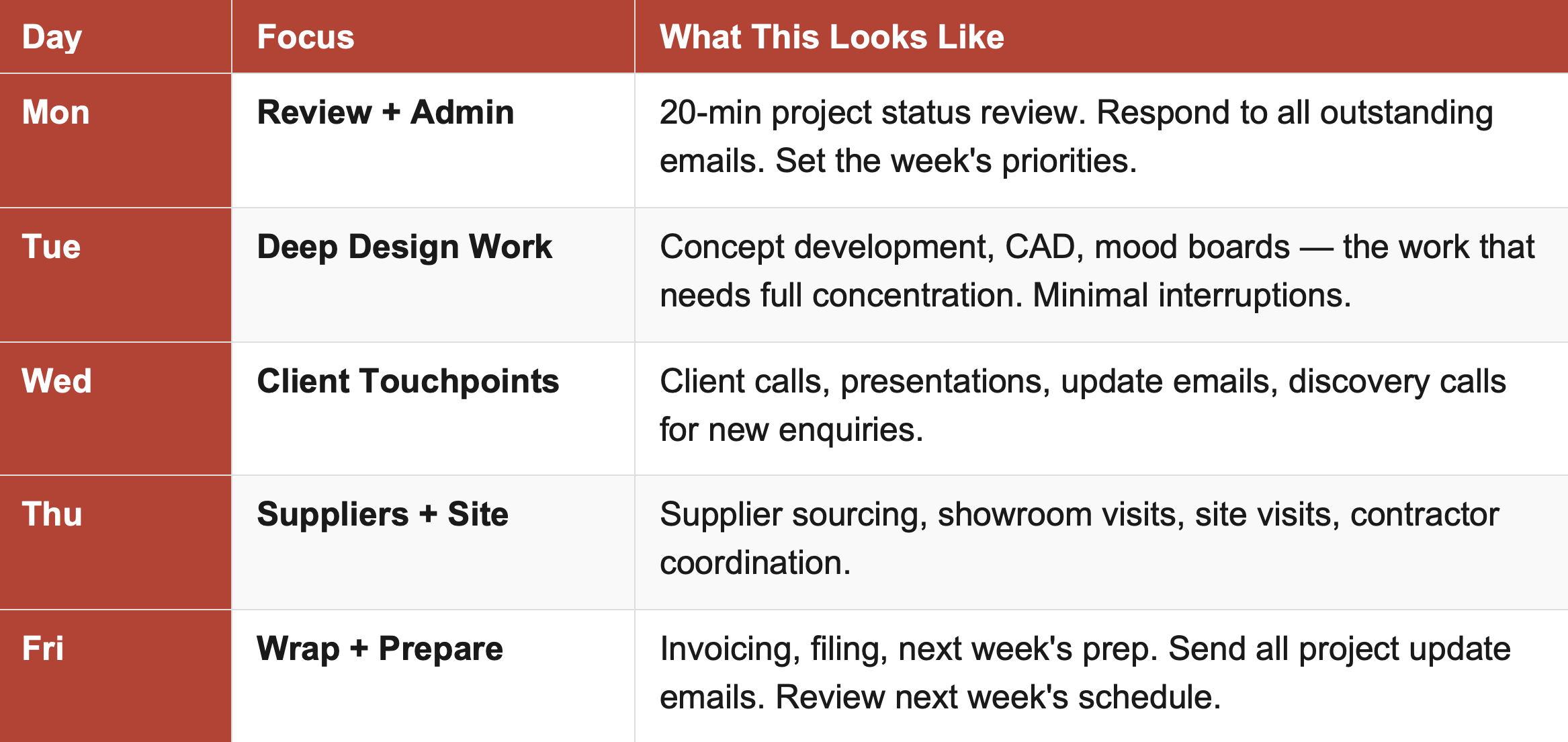
The goal of a weekly rhythm isn't rigidity. It's predictability — for you and for your clients. When you know which days are for which work, you stop reactively responding to everything and start proactively managing everything.
FIND THE RIGHT TEMPLATES FOR YOUR INTERIOR DESIGN PROJECTS
Communicating With Multiple Clients Without Anyone Feeling Forgotten
One of the quietest fears of a multi-project designer is that one client will feel neglected while you're focused on another. The solution isn't doing more — it's communicating better.
The weekly project update email
A brief, structured email at the same time each week — even when there's nothing major to report — keeps clients informed and reassured. It doesn't have to be long:
'Hi [name], a quick update from this week: [supplier X] confirmed delivery for [date], and I've finalised the lighting specification for the living room. Next week I'll be preparing the FF&E schedule for your review. No action needed from you right now — just wanted to keep you in the loop. Have a great weekend.'
Three sentences. Two minutes. One client who feels looked after.
The waiting-on-you nudge
Every project has moments where it stalls because a client hasn't made a decision or returned an approval. These delays compound across multiple projects. Build a habit of flagging these explicitly — with a clear deadline — rather than waiting and hoping.
The 'this week's focus' transparency
Some designers share openly with clients when they're in deep work mode on another project: 'I'm presenting to another client mid-week so I'll have your revised drawings to you by Friday rather than Wednesday.' Most clients appreciate the honesty and the heads-up. What they don't appreciate is silence and then a missed deadline.
The weekly project update email
A brief, structured email at the same time each week — even when there's nothing major to report — keeps clients informed and reassured. It doesn't have to be long:
When It's Getting Too Much: The Signs to Watch For
Even with good systems, there are times when the load genuinely exceeds capacity. Recognising the signs early gives you options. Ignoring them until something breaks doesn't.
You're consistently missing your own self-imposed deadlines across projects
Client emails are sitting unanswered for more than 48 hours regularly
You can't clearly remember the status of each project without checking your notes
You're making decisions on one project while thinking about another
The quality of your work is declining — you can feel it even if clients can't yet
When two or more of these are true, it's time to act — either by declining a new project, bringing in support, or having an honest conversation with a client about revised timelines. All three of these feel uncomfortable. None of them are as damaging as letting the overload continue silently until something fails visibly.
🙋 Asking for Help Isn't Weakness
Many designers try to manage multi-project overload alone because bringing in support — a junior designer, a PA, a virtual assistant for admin — feels like an admission of failure. It isn't. It's the same capacity thinking that allows any professional service business to scale. The question isn't whether you can handle everything alone. It's whether handling everything alone is the best use of your time and the best outcome for your clients.
The Mindset Shift That Changes Everything
Designers who manage multiple projects well have usually made one key shift in how they think about their work: they've stopped thinking of themselves purely as a creative practitioner and started thinking of themselves as a studio.
A studio has systems, schedules, and processes. It doesn't run on inspiration and reactive responses. It plans ahead, communicates proactively, and treats project management as a professional skill that is just as important as spatial thinking or material knowledge.
That shift doesn't make the work less creative. It makes the creativity sustainable — protected by the structure around it, rather than constantly threatened by the chaos within it.
Systems don't constrain creativity. They protect it. The designer who is never behind, never overwhelmed, never scrambling — that designer has more creative energy, not less.
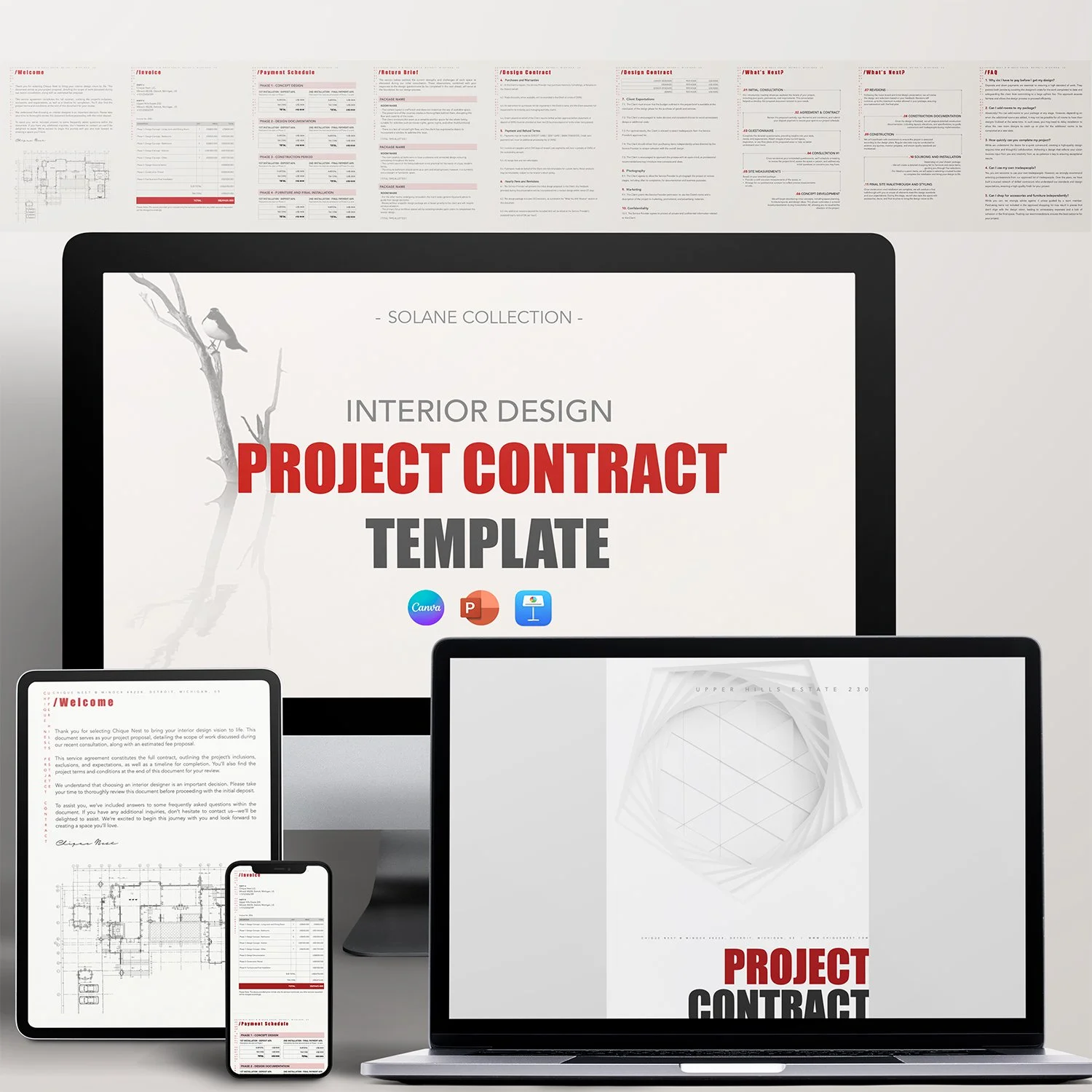
Juggling multiple clients is far smoother when every project starts from the same professional foundation. Chique Nest's onboarding packs, project templates, and client communication tools mean you're not rebuilding from scratch every time a new project kicks off.

Stop sending clients a plain PDF and hoping it lands. The Chique Nest Project Proposal Template gives you a beautifully laid-out proposal that shares your inspiration, goals, requirements, mood board, and timeline — everything a client needs to say yes.
Tells the Full Design Story: From inspiration and design goals through to project requirements and mood board, clients see your thinking, not just your pricing.
Fully Customizable: Easily tailor fonts, colors, images, and layouts in Canva, PowerPoint, or Keynote to reflect your brand's unique identity.
Visual Project Timeline: A clean 5-phase timeline graphic so clients know exactly what to expect and when.
Past Work Built In: Dedicated "Our Works" pages with room to showcase real projects and client testimonials.
Save Time and Effort: Stop rebuilding a proposal deck from scratch for every new lead — just update the project details.
—— 📨 What’s Included in the download?
You’ll receive:
✅ 5 Files Total
• PDF with Download Link + Instruction Manual
• 1 Keynote Template
• 1 PowerPoint Template
• 1 Canva Template
• 1 PDF Example File by Chique Nest
✅ 17 Fully Editable Pages
—— 🖌️ What’s inside the template?
This comprehensive project proposal includes every section you need to pitch and win a new project:
✔️ Welcome
✔️ Finding Inspiration
✔️ Design Goals
✔️ Project Requirements
✔️ Mood Board
✔️ Project Timeline
✔️ Terms
✔️ Design Process
✔️ Next Steps
✔️ Our Works
✔️ Meet Our Team
✔️ Contact Us
—— 📂 File Format & Compatibility:
Available in Widescreen (16:9) format, this template is compatible with:
✔️ Canva (requires a free Canva account)
✔️ PowerPoint
✔️ Keynote
All elements are fully customizable, including fonts, text, images, and branding.