

SEO for Interior Designers: How to Get Found on Google Without Running Ads
Every interior designer wants to be found on Google. But most don't know where to start — and the ones who've Googled 'how to do SEO' have usually ended up more confused than when they started, drowning in technical jargon that feels designed for developers, not designers.
Here's the truth: SEO is not that complicated for a local service business. You don't need to understand server architecture or write code. You need to understand what your clients search for, create content that answers those searches well, and make your website easy for Google to read.
That's the whole game. This guide walks you through it — practically, plainly, and without the fluff.
SEO is not about tricking Google. It's about being genuinely useful to the people who are already looking for what you do.
Why SEO Matters More for Interior Designers Than Most People Think
Social media builds awareness. Word of mouth builds trust. But Google captures intent — it's where people go when they've already decided they want something and they're looking for who to give their money to.
Think about the searches that your ideal client makes in the weeks before hiring a designer:
"interior designer [city name]"
"how much does interior design cost"
"interior designer for kitchen renovation"
"best interior designers near me"
"how to find a good interior designer"
These are high-intent searches — people actively looking to hire. If you're not appearing in these results, someone else is. And unlike a social media post that disappears in 24 hours, a well-optimised page or blog post can bring in enquiries for years.
A page that ranks on Google doesn't clock off. It works while you're on site, in a client meeting, or asleep. That's the compounding value of SEO.
The Four Pillars of SEO for Interior Designers
Forget the overwhelming lists of 200 ranking factors. For a service-based creative business, SEO comes down to four things — and doing them well covers 80% of what matters.
1 — Keyword Research — Know What Your Clients Are Actually Searching
Keywords are the phrases your ideal clients type into Google. Your job is to know what those phrases are and make sure they appear naturally throughout your website and content. Start local ('interior designer Edinburgh'), then go specific ('luxury kitchen designer Edinburgh'), then go informational ('how much does kitchen interior design cost in the UK'). All three types matter.
2 — On-Page SEO — Help Google Understand Your Website
Every page on your website sends signals to Google about what it's about. Your page title, headings, URL, meta description, image file names, and body copy all contribute. This isn't about stuffing keywords — it's about being clear and specific so Google knows exactly who you are, where you are, and what you do.
3 — Content — Give Google a Reason to Keep Sending People to You
A static website with five pages will plateau. A website that regularly publishes useful, relevant content tells Google that you're active, expert, and worth recommending. Blog posts that answer the questions your clients ask — on budget, process, style, location — are the single best long-term SEO investment you can make.
4 — Backlinks & Authority — Get Other Sites to Vouch for You
When reputable websites link to yours, Google interprets it as a vote of confidence. You don't need hundreds of backlinks — a handful of relevant, high-quality ones from local press, design directories, supplier websites, or industry blogs can meaningfully improve your rankings.
FIND THE RIGHT TEMPLATES FOR YOUR INTERIOR DESIGN PROJECTS
Keyword Research Without the Overwhelm
You don't need expensive tools to find good keywords. You need to think like your client — then verify your instincts. Here's a simple process:
Step 1: Brainstorm the obvious ones
Write down every phrase a potential client might use to find someone like you. Include your location, your speciality, your typical project type. Don't filter yet — just list.
Step 2: Check Google's own suggestions
Type your guesses into Google and look at the autocomplete suggestions — these are real searches people make. Scroll to the bottom of the results page and look at 'People also search for.' These are free keyword ideas directly from Google's data.
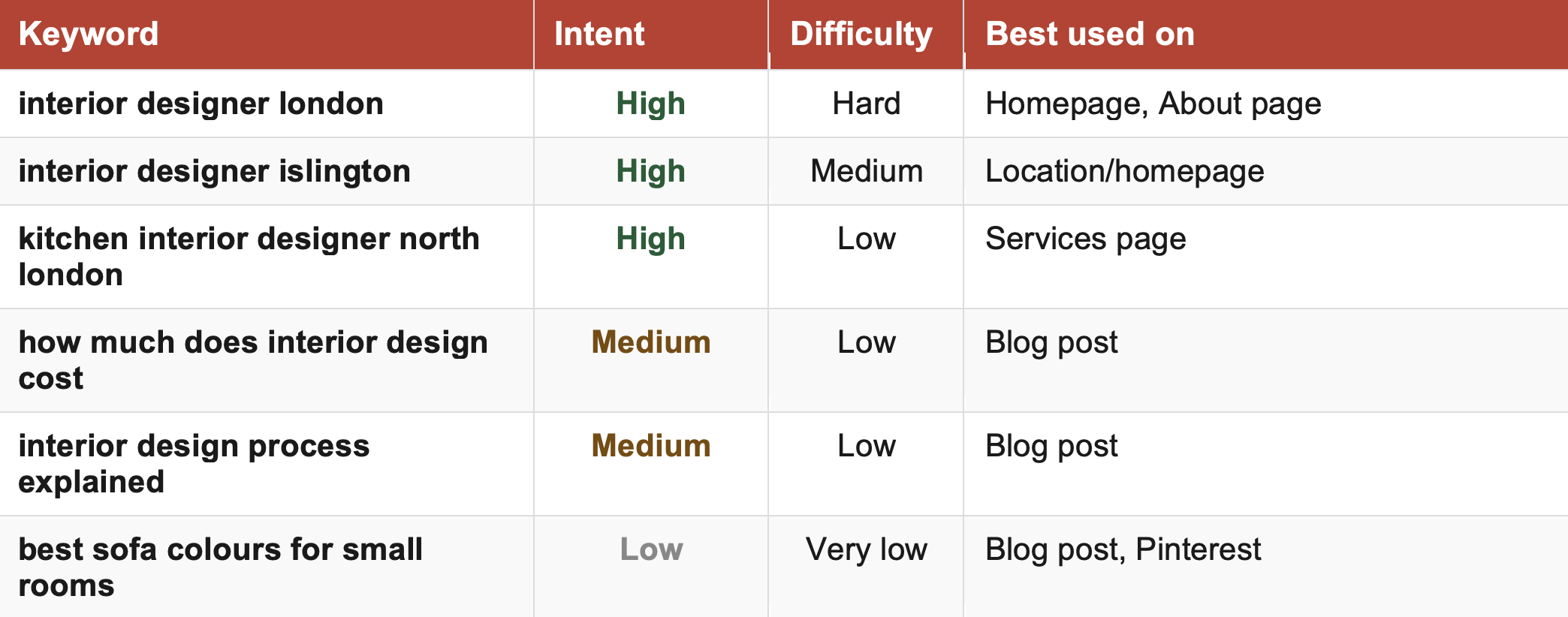
Step 3: Prioritise by intent and specificity
On-Page SEO: The Checklist
For every key page on your website — homepage, services, about, contact — run through this checklist. It takes about 15 minutes per page and covers the fundamentals.
✓ Page title includes your primary keyword — e.g. 'Interior Designer in Edinburgh | Residential & Kitchen Design'
✓ URL is clean and descriptive — e.g. /interior-designer-edinburgh not /page-2
✓ Meta description is written (150–160 chars) — Summarises the page and includes a keyword naturally
✓ H1 heading includes the primary keyword — Only one H1 per page — make it count
✓ Body copy uses keywords naturally — No stuffing — write for humans, include keywords where they fit
✓ Images have descriptive file names — e.g. 'edinburgh-kitchen-interior-design.jpg' not 'IMG_4592.jpg'
✓ Images have alt text — A short description of what the image shows — helps accessibility and SEO
✓ Page loads fast on mobile — Use Google's PageSpeed Insights to check — most sites lose rankings on mobile speed
✓ Internal links connect related pages — Link your services page to relevant blog posts and vice versa
✓ Google Search Console is set up — Free tool from Google — tells you which searches bring people to your site
The Blog: Your Long-Game SEO Weapon
Static website pages can only rank for so many keywords. A blog — or 'journal' as many designers call it — lets you create a new page targeting a new keyword every time you publish. Over time, this compounds significantly.
The key is writing posts that answer specific questions your clients are already searching for. Not 'here's what I've been up to' diary posts — but genuinely useful content that earns its place in search results.
Blog post ideas with strong SEO potential for interior designers
"How much does a full home renovation cost in [city]?"
"How to choose an interior designer: what to look for and what to ask"
"Open plan living vs. separate rooms: which works for family homes?"
"The best kitchen layouts for small spaces"
"How long does an interior design project take from start to finish?"
"What's included in an interior design fee?"
"How to mix old and new furniture without it looking cluttered"
📝 One Post, One Keyword
Each blog post should target one primary keyword — the specific phrase you want that post to rank for. Mention it in the title, the first paragraph, at least one subheading, and naturally throughout the body. Don't try to target multiple keywords in a single post. One topic, one keyword, one focused piece of content.
Local SEO: The Fastest Win for Most Designers
If you serve clients in a specific city or region, local SEO is your highest-return focus. When someone searches 'interior designer near me' or 'interior designer [city]', Google prioritises local results — and showing up there is far more achievable than competing globally.
Google Business Profile
This is non-negotiable. A free Google Business Profile puts you on Google Maps and in the local search results panel. Set it up completely — business name, category ('Interior Designer'), location, website, photos of your work, and a compelling description. Ask satisfied clients to leave a Google review. Reviews are one of the strongest local ranking signals.
Location pages
If you serve multiple areas, consider creating a dedicated page for each — 'Interior Designer in [Area]' — with genuine, specific content about that location. Thin pages with identical content just swapping the city name won't work. Write something actually useful about designing in that area.
Local citations
Get your business listed consistently on local directories — Houzz, Checkatrade, Bark, Yell, and any relevant local business directories. Consistent name, address, and phone number across all listings strengthens your local SEO signal.
⭐ Reviews Are a Ranking Signal
Google reviews don't just build social proof — they actively improve your local search ranking. After every completed project, make it a habit to ask happy clients for a Google review. A short, personal request via email or text works better than a generic follow-up. Five genuine reviews will do more for your local SEO than an afternoon of technical optimisation.
How to Know If It's Working
SEO results take time — typically three to six months before you see meaningful movement. But you can track progress from day one with a few free tools:
Google Search Console — shows which searches bring people to your site, your average position, and which pages get clicks. This is your most important SEO dashboard.
Google Analytics 4 — shows overall website traffic, where visitors come from, and which pages they spend time on.
Google Business Profile Insights — for local SEO, shows how many people found you via Google Maps, called you, or visited your website from the listing.
Check these once a month. Look for trends, not day-to-day fluctuations. The metrics that matter most: organic search traffic over time, keyword rankings moving upward, and — most importantly — enquiries that mention finding you on Google.
Where to Start If You're Doing This From Scratch
SEO can feel infinite if you try to do everything at once. It isn't — if you sequence it properly. Here's the order that gives you the fastest returns:
Week 1: Set up Google Search Console and Google Business Profile. Claim your listing, fill it out completely, upload photos.
Week 2–3: Audit your homepage and services pages against the on-page checklist. Fix titles, meta descriptions, and H1s.
Month 1–2: Write your first two blog posts targeting specific questions your clients ask. Publish them. Share them on social.
Month 3 onwards: Publish one new blog post per month minimum. Ask completed project clients for Google reviews. Build one or two backlinks per quarter.
That's a twelve-month SEO strategy that any designer can execute without an agency, without a big budget, and without deep technical knowledge. The results won't be instant — but they will compound, and they will not stop working when you stop paying for them.
The designers who dominate local Google searches didn't do anything magic. They showed up consistently, wrote useful content, and gave clients a reason to leave reviews. That's the whole strategy.
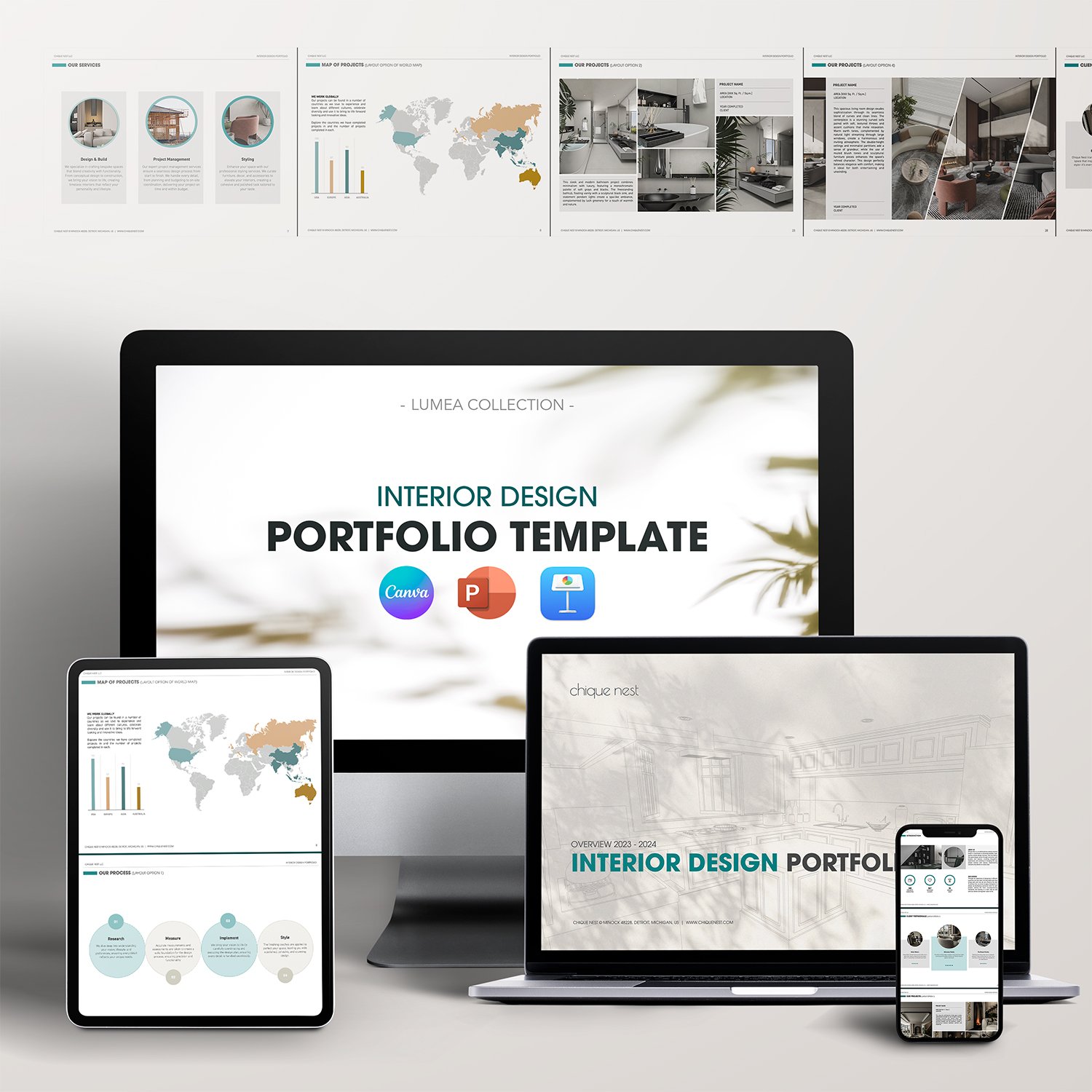
A great SEO strategy needs great content to back it up. Chique Nest's resources — from AutoCAD guides to business tools — give you the expertise and professional polish that build the kind of authority Google rewards over time.

Simplify your client onboarding process and clearly showcase your offerings with The Lumea Collection Packages & Pricing Template. Designed specifically for interior designers, this template provides a polished and professional way to present your services, pricing, and packages, helping you stand out and build trust with prospective clients.
Clearly Communicate Your Services: Highlight your package options, e-packages, and pricing details in a clean and organized format.
Fully Customizable: Easily tailor fonts, colors, images, and layouts in Canva, PowerPoint, or Keynote to reflect your brand’s unique identity.
Comprehensive and Client-Focused: Cover every detail, from client testimonials to package comparisons, ensuring transparency and building confidence.
Save Time and Effort: With thoughtfully designed layouts and pre-written content, you can quickly create stunning presentations that make a lasting impression.
Professional Presentation: Showcase your expertise and build trust by providing a clear and visually appealing document that simplifies decision-making for your clients.
—— 📨 What’s Included in the download?
You’ll receive:
✅ 12 Files Total
• PDF with Download Link + Instruction Manual
• 4 Keynote Files
• 4 PowerPoint Files
• 2 Canva Templates
• 1 PDF File
✅ 16 Fully Editable Pages in Two Beautiful Themes:
1. Golden Elegance
2. Turquoise Modern
—— 🖌️ What’s inside the template?
This comprehensive packages and pricing template includes all the sections you need to professionally present your interior design business:
✔️ Welcome
✔️ About Us
✔️ Client Testimonials
✔️ Our Team
✔️ What’s Next?
✔️ What to Expect
✔️ Packages Options
✔️ E-Packages Options
✔️ Packages Comparison
✔️ E-Packages Comparison
✔️ Questions & Answers
✔️ Contact Us
—— 📂 File Format & Compatibility:
Available in both Standard (4:3) and Widescreen (16:9) formats, this template is compatible with:
✔️ Canva (requires a free Canva account)
✔️ PowerPoint
✔️ Keynote
All elements are fully customizable, including fonts, text, images, and branding.