

How to Build a Waitlist for Your Interior Design Business
Picture two designers. Same skills, same city, similar portfolios.
The first checks their inbox every morning hoping for an enquiry. When one comes in, they respond within the hour, agree to a call that afternoon, and quote whatever feels safe enough not to lose the job. They are always available. They are never quite fully booked.
The second has a note on their website: "Currently booking for Q3. Join the waitlist to be first to hear about availability." When an enquiry comes in, they respond warmly, explain their timeline, and invite the prospect to register their interest. By the time a slot opens up, three people are waiting for it.
Same skills. Completely different leverage.
A waitlist isn't just a scheduling tool. It's a signal — to clients, to the market, and to yourself — that your time has a value that exceeds its immediate supply. And building one is less about being lucky enough to be in demand, and more about deliberately creating the conditions where demand exceeds availability.

A waitlist doesn't mean you're too busy. It means you've built a business where demand leads supply — and that changes everything.
What a Waitlist Actually Does for Your Business
Before the tactics, it's worth being clear about what you're actually building — because a waitlist isn't just a list of names. It's a positioning mechanism that does several things at once.
Niching isn't about doing less. It's about being known for something specific — so that the right clients can actually find you.
1 — It signals demand — even before demand is real
Publicly communicating that you're booked ahead creates a perception of scarcity that attracts exactly the kind of client who plans ahead, respects your time, and doesn't expect you to drop everything for them. The signal itself shapes the audience that responds to it.
2 — It removes the desperation energy that repels good clients
Clients can sense when a designer needs the work. It shifts the power dynamic in ways that lead to underpriced projects, scope creep, and difficult relationships. A waitlist changes your posture entirely — you're not pitching, you're selecting.
3 — It creates a pipeline you control
Instead of feast-or-famine cycles where you're either overwhelmed or anxious about where the next project is coming from, a waitlist gives you visibility into what's ahead. You can plan, pace, and price accordingly.
4 — It gives you a reason to stay in touch
A waitlist is a warm audience — people who have already raised their hand and said 'I'm interested.' That's a genuinely valuable asset for any business.
FIND THE RIGHT TEMPLATES FOR YOUR INTERIOR DESIGN PROJECTS
The Honest Truth: You Probably Need to Do This Before You're Ready
Here's where most designers get stuck: they think a waitlist is something that happens to you once you're successful enough. That you earn it. That you wait until you're so overwhelmed with work that a waitlist becomes necessary.
That's not how it works.
The waitlist is a cause, not just an effect. You build it deliberately — through positioning, visibility, and a few simple systems — and the demand follows. Designers who wait until they organically need a waitlist almost never build one, because the conditions that would create organic overflow are the same conditions a waitlist helps you build toward.

The Four Things You Actually Need to Build a Waitlist
None of these require a big budget or a big audience. They require clarity, consistency, and a willingness to show up as a designer who is worth waiting for.
1. A clear, specific positioning
A waitlist for 'an interior designer who does residential and commercial work' is very hard to fill. A waitlist for 'a luxury residential designer specialising in family homes in South London' is specific enough that the right person immediately knows whether they're on it or not.
Your positioning doesn't have to be perfectly tight yet — but the more clearly you can describe who you work with and what you do, the faster the right clients will self-select into your pipeline.
2. A consistent visibility strategy
People can't join a waitlist they don't know exists. You need to be showing up somewhere — Instagram, Pinterest, a blog, a newsletter, LinkedIn, local networking — with enough regularity that the right people see your work, understand what you do, and remember you when the time comes.
Consistency matters far more than frequency. Posting three times a week for six months will do more for a waitlist than posting daily for three weeks and then going quiet.
📱 Where to Show Up
You don't need to be everywhere. Pick one or two platforms where your ideal client actually spends time, and commit to them. For most residential interior designers, Instagram and Pinterest are the highest-ROI channels. Show your work, your process, your personality — and make your availability status visible.
3. A simple way to capture interest
This doesn't need to be complicated. At minimum:
A line on your website or Instagram bio: "Currently booking for [season/quarter] — enquire to join the waitlist"
A contact form or email address where interested clients can register
A simple response template acknowledging their interest and setting expectations on timeline
Some designers use a dedicated waitlist page on their site with a short form. Others keep it as simple as a DM or email. The mechanism matters far less than the habit of communicating availability consistently.
4. A reason to be worth waiting for
This is the part that makes everything else sustainable. If clients join your waitlist and the experience they get when they finally work with you doesn't justify the wait — they won't refer others. They won't return. The waitlist becomes a revolving door instead of a compounding asset.
The experience that makes a waitlist worth building includes: a proposal that looks exceptional, an onboarding process that feels considered, communication that is clear and professional, and work that delivers on what you promised. Every touchpoint is part of it.
Waitlist Messaging: Do This, Not That
The language you use around your availability shapes how it's perceived. Here's the difference between messaging that builds desirability and messaging that just sounds like you're busy.
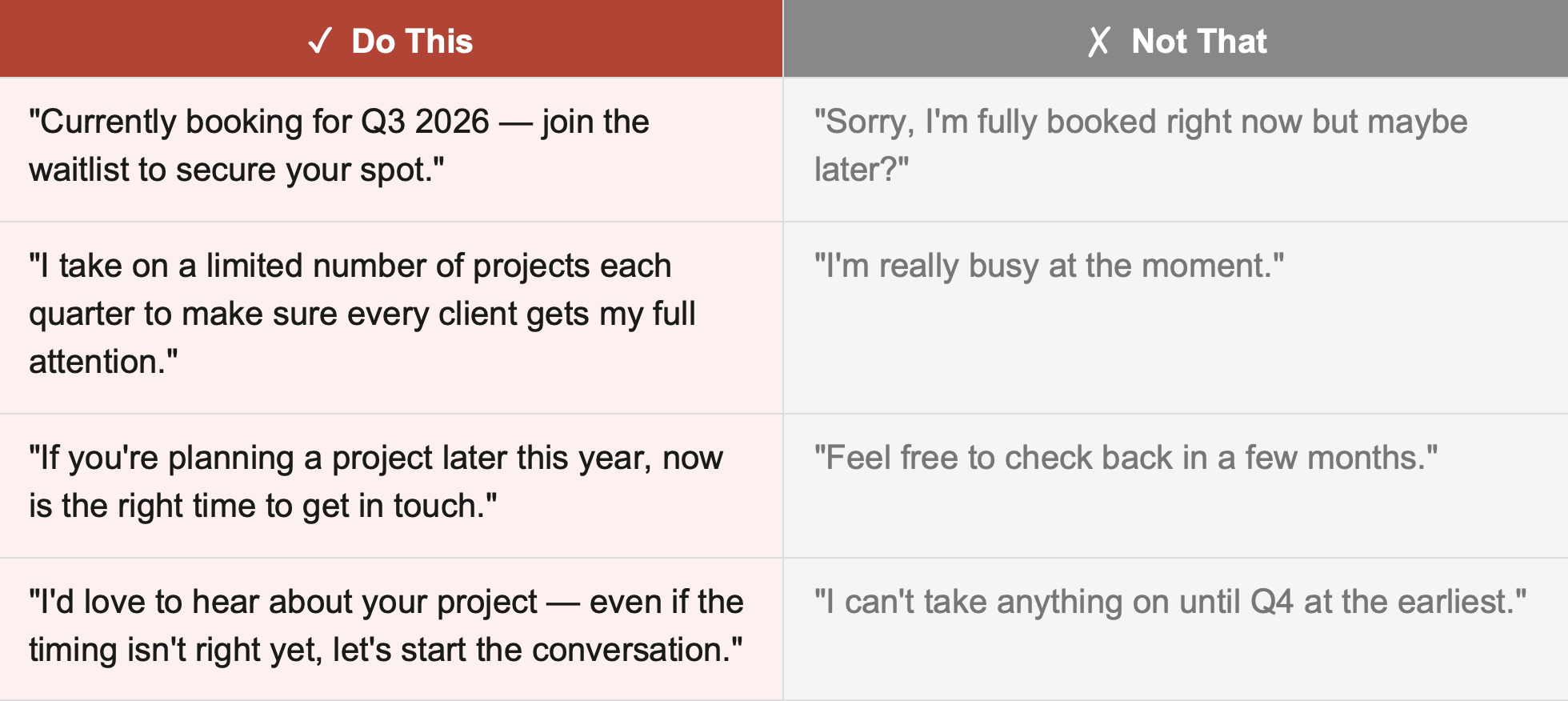
The left column communicates the same reality as the right column — you're booked. But it does it in a way that makes being on the waitlist feel like an opportunity, not a consolation prize.
Actually Managing Your Waitlist (Without It Becoming a Headache)
A waitlist only works if you actually follow up with people on it. A list of names in your inbox that you never contact isn't a waitlist — it's a record of missed opportunities.
Keep it simple
A spreadsheet with name, contact, project type, rough timeline, and date of enquiry is all you need. Review it at the start of each month. When a slot is opening up, contact the most relevant person first — not just whoever's been waiting longest, but whoever is the best fit for what you have available.
Stay warm with occasional touchpoints
If someone joins your waitlist and doesn't hear from you for four months, the moment has passed. A brief personal note every 6-8 weeks — sharing a project update, asking if their timeline has changed, pointing them to a relevant blog post — keeps the relationship alive without being pushy.
Be honest about timelines
If your waitlist is running longer than expected, tell people. Most clients who genuinely want to work with you will wait — as long as you're communicating. What they won't tolerate is being kept in the dark and then surprised when you finally reach out.
🗂️ One Simple System
Create a 'Waitlist' label or folder in your email and a corresponding tab in a simple spreadsheet. Every Friday, spend five minutes reviewing it. That's the whole system. The designers who manage waitlists well aren't using fancy CRM tools — they're just being consistently attentive.
Starting From Zero: How to Build the First Version
If you don't have a waitlist yet and the idea of saying 'I'm fully booked' feels dishonest — here's how to think about it.
You're not lying about your current capacity. You're communicating your desired capacity — and positioning yourself for the business you're building, not just the one you have today. Every designer who now genuinely has a waitlist started by deciding to behave like a designer who would.
Start with these three moves:
Update your website and bio to reference your booking timeline — even if it's only a few weeks out
When an enquiry comes in that you can't take immediately, mention the waitlist and invite them to register interest rather than just saying no
Post on social media once a month about your current availability — even 'booking into [month]' builds the impression of a busy, in-demand practice
Do these three things consistently for three months. The behaviour shapes the reality far faster than waiting for the reality to arrive on its own.
The Bigger Shift
Building a waitlist isn't just a business tactic. It's a shift in how you relate to your own time and your own value. It's the decision to stop being reactive — taking whatever comes in — and start being intentional about who you work with, when, and on what terms.
That shift doesn't happen overnight. But it starts with one decision: to stop treating your availability as a default yes, and start treating it as something worth protecting.
The designers with the most satisfying, most profitable practices didn't get lucky with demand. They built a business that made demand inevitable — and then made sure it couldn't outpace them.
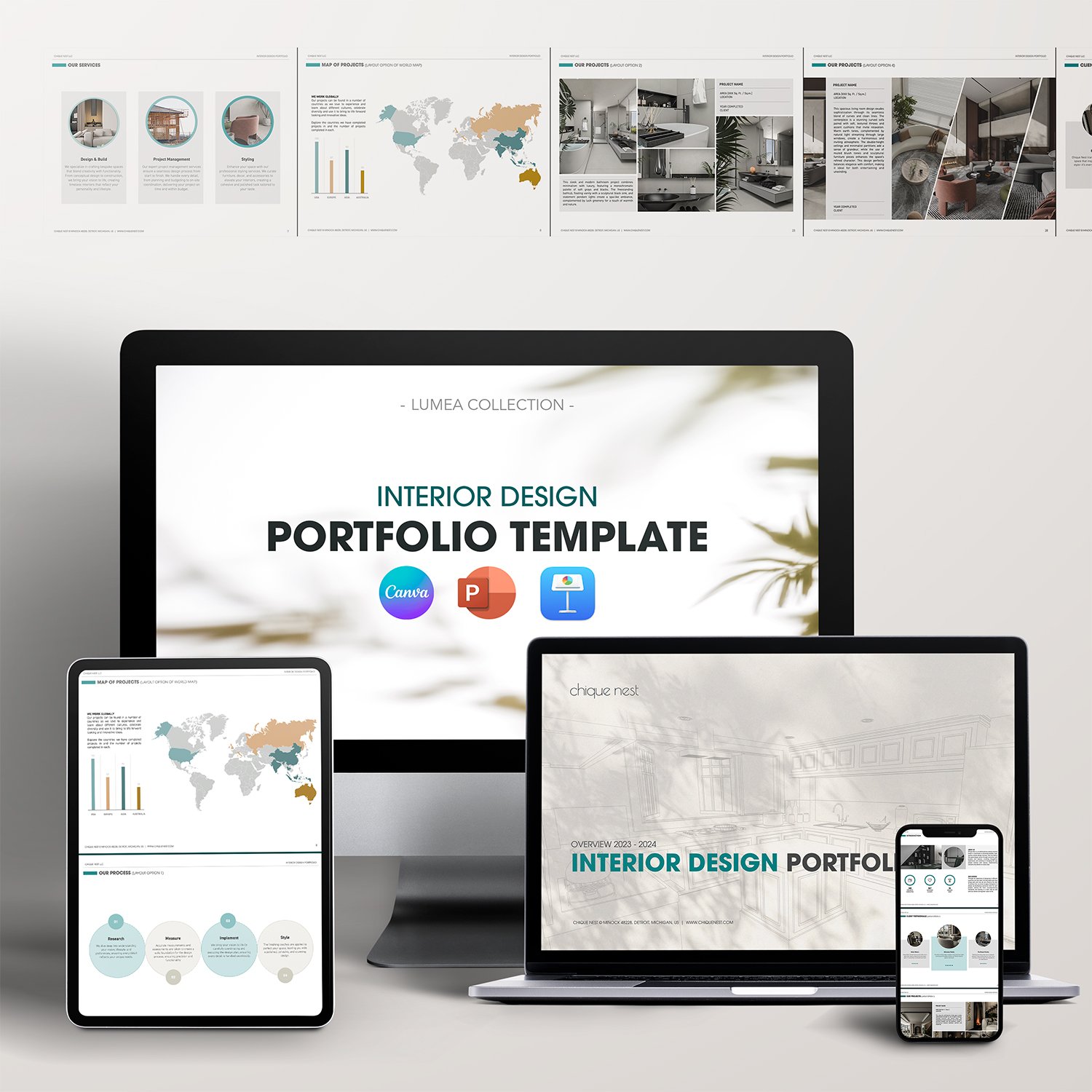
A waitlist only works if the experience clients get when they finally book is worth the wait. Chique Nest's onboarding templates, proposal packs, and client presentation tools make sure your first impression — and every impression after — is exactly what it should be.

Simplify your client onboarding process and clearly showcase your offerings with The Lumea Collection Packages & Pricing Template. Designed specifically for interior designers, this template provides a polished and professional way to present your services, pricing, and packages, helping you stand out and build trust with prospective clients.
Clearly Communicate Your Services: Highlight your package options, e-packages, and pricing details in a clean and organized format.
Fully Customizable: Easily tailor fonts, colors, images, and layouts in Canva, PowerPoint, or Keynote to reflect your brand’s unique identity.
Comprehensive and Client-Focused: Cover every detail, from client testimonials to package comparisons, ensuring transparency and building confidence.
Save Time and Effort: With thoughtfully designed layouts and pre-written content, you can quickly create stunning presentations that make a lasting impression.
Professional Presentation: Showcase your expertise and build trust by providing a clear and visually appealing document that simplifies decision-making for your clients.
—— 📨 What’s Included in the download?
You’ll receive:
✅ 12 Files Total
• PDF with Download Link + Instruction Manual
• 4 Keynote Files
• 4 PowerPoint Files
• 2 Canva Templates
• 1 PDF File
✅ 16 Fully Editable Pages in Two Beautiful Themes:
1. Golden Elegance
2. Turquoise Modern
—— 🖌️ What’s inside the template?
This comprehensive packages and pricing template includes all the sections you need to professionally present your interior design business:
✔️ Welcome
✔️ About Us
✔️ Client Testimonials
✔️ Our Team
✔️ What’s Next?
✔️ What to Expect
✔️ Packages Options
✔️ E-Packages Options
✔️ Packages Comparison
✔️ E-Packages Comparison
✔️ Questions & Answers
✔️ Contact Us
—— 📂 File Format & Compatibility:
Available in both Standard (4:3) and Widescreen (16:9) formats, this template is compatible with:
✔️ Canva (requires a free Canva account)
✔️ PowerPoint
✔️ Keynote
All elements are fully customizable, including fonts, text, images, and branding.