

How to Communicate Design Decisions to Clients Who Don't Speak 'Design'
You've spent weeks on a concept. You know why every decision is right — the material choice, the spatial logic, the way the light moves through the room at different times of day. You've thought about it from every angle.
Then you present it to your client. And you watch their face do that thing — the polite nod that doesn't quite reach their eyes. The 'it's interesting' that means something closer to 'I'm not sure.' The silence where enthusiasm should be.
It's one of the most frustrating moments in interior design. Not because the work isn't good — it is — but because the gap between what you understand and what your client can see hasn't been bridged yet.
That gap is a communication problem. And communication problems are solvable.

A design that can't be understood by the client can't be approved by the client. Communication is part of the craft.
The Root of the Problem: You're Fluent in a Language Your Client Hasn't Learned
Interior designers develop a professional vocabulary over years of training and practice. Terms like 'visual weight', 'circulation', 'biophilic', 'juxtaposition', 'tension', 'layering' — these are precise and useful when talking to other designers. When talking to a client who renovates their home once every decade, they can land as meaningless noise.
It's not that clients are unsophisticated. Many are highly intelligent, successful people in their own fields. But design is not their field. They experience space instinctively — they know what feels right — but they often lack the language and the visual literacy to evaluate a design rationally before it exists.
Your job is to meet them where they are — not to simplify your thinking, but to translate it.
The translation gap in action
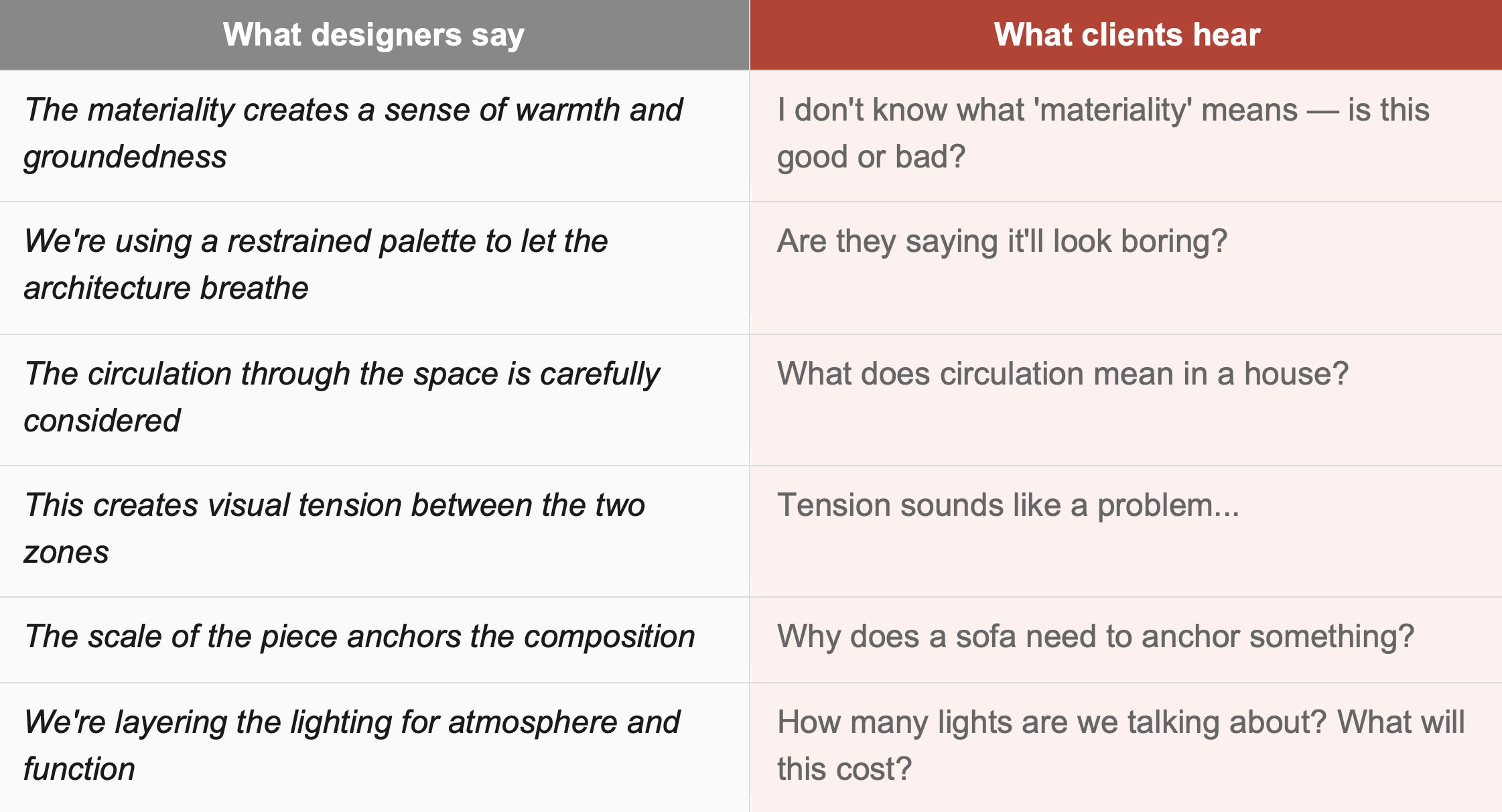
None of these phrases are wrong. They're simply not landing. The solution isn't to stop using the concepts — it's to make the concepts tangible before you use the terminology.
The Four Principles of Client-Facing Design Communication
1. Lead with the feeling, follow with the reasoning
Clients don't primarily evaluate design rationally — they feel it first. Before you explain why a decision is correct, tell them what it will feel like to live with it.
Not: 'The warm oak tones are chosen to complement the existing architectural envelope.' But: 'When you walk into this room on a dark winter morning, the warmth of the oak will make it feel like the room is already lit from within — before you've even turned on the lights.'
Same information. Completely different experience of receiving it.
2. Anchor abstract concepts in physical reality
Spatial concepts like scale, proportion, and flow are hard for non-designers to visualise. Always anchor them in something concrete — a measurement, a comparison, a physical experience.
Instead of 'the oversized mirror enhances the sense of depth,' try: 'This mirror is 180cm tall — it'll reflect the garden view from anywhere in the room, and from the sofa it'll feel like looking through a window.'
3. Give them the why in their terms, not yours
Clients want to understand the reasoning behind decisions — not because they want to second-guess you, but because understanding makes them feel confident they're getting value. But the 'why' needs to be framed in terms they care about: comfort, practicality, longevity, value, how the space will be used.
'This sofa fabric is a performance weave' means very little. 'This fabric is the same grade used in hotel lobbies — it'll look immaculate in five years even with daily use' means everything.
4. Show, don't just tell
No amount of verbal explanation substitutes for a well-prepared visual. Mood boards, material samples, reference images, 3D renders, and floor plans are not optional extras — they are the primary language through which non-designers understand space. The more visual your presentation, the less explaining you have to do.
Reframing Your Design Language
Here are some of the most common instances of designer vocabulary getting lost in translation — with plain-language alternatives that communicate the same idea more effectively.





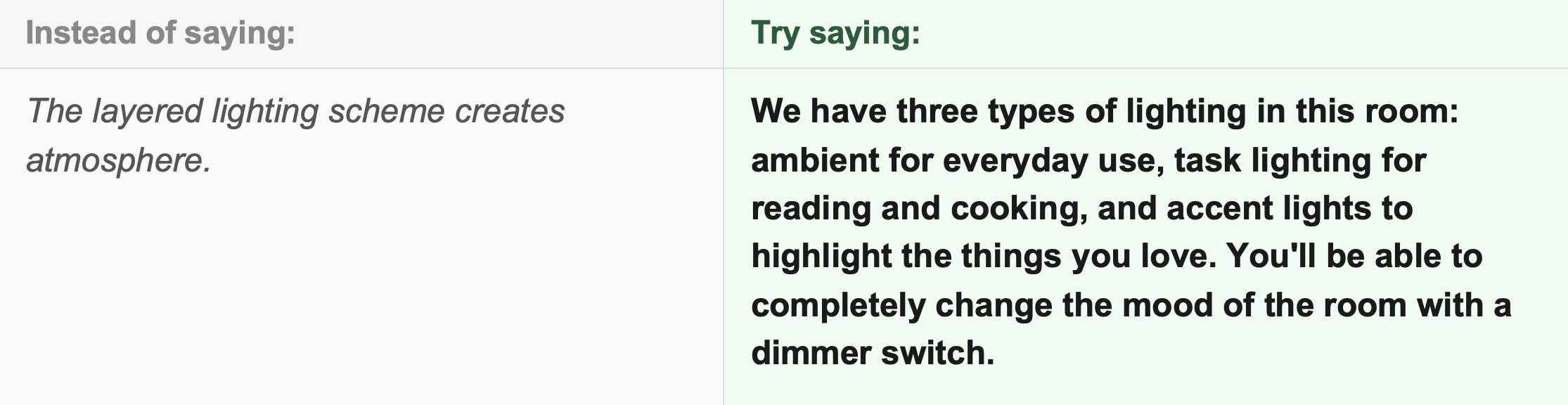
FIND THE RIGHT TEMPLATES FOR YOUR INTERIOR DESIGN PROJECTS
The Three Moments That Make or Break Client Understanding
Communication isn't just about the words you choose — it's about timing. These are the three moments in every project where clarity of communication has the biggest impact.
The Concept Presentation
The challenge: Clients are seeing something new and abstract. They want to love it but they may not know how to yet.
The approach:Open by connecting the concept to what they told you they wanted — at the brief stage. 'You said you wanted the kitchen to feel like the heart of the home. Everything you're about to see comes from that.' Ground the visual in the brief before you show a single image. Then walk through the mood board or presentation piece by piece, leading with feeling and following with reasoning for each element.
Material and Specification Sign-Off
The challenge: Clients are being asked to approve items they may have never seen in physical form at full scale.
The approach:Whenever possible, present physical samples rather than digital swatches. Put the tile sample on the floor next to the paint chip next to the fabric. Let them see how the materials relate to each other in real light. For items that can't be brought to the meeting, show them installed in reference images — not product shots on a white background.
The Problem-Solving Conversation
The challenge: Something has changed — a product is discontinued, a measurement is off, a decision needs revisiting. Clients can easily interpret these as failures rather than normal parts of the process.
The approach:Lead with the solution, not the problem. 'I've found an alternative for the kitchen tap that I actually prefer — here's why' lands very differently to 'the tap we specified is no longer available.' Same situation. The first version keeps you in control of the narrative and maintains client confidence.
Reading the Room: Signs Your Client Is Lost
Sometimes clients don't tell you they're confused — they just disengage, or they start asking questions that seem tangential, or they give lukewarm approval to decisions they're actually unsure about. Learn to read the signals:
Responses like 'that's interesting' or 'I suppose that could work' — these are uncertainty, not endorsement
Questions about price immediately after a design decision — often a deflection from aesthetic uncertainty ('if I'm not sure I like it, at least I'll understand the cost')
Silence followed by 'I'll need to think about it' — usually means they can't visualise it yet
Contradicting a decision they already approved — often means they said yes without fully understanding what they were agreeing to
Bringing in a third opinion (partner, parent, friend) — sometimes a genuine need, but often a sign they want someone else to help them understand something they're uncertain about
When you see these signals, pause. Don't push forward. Ask: 'Is there a part of this I can show you differently?' or 'Would it help to see this in context with the other materials?' Slowing down at these moments saves time overall.
The Most Powerful Question in a Client Presentation
'What would you need to see to feel confident about this decision?' It removes the vagueness of a hesitant response and gives you something specific to address. Most clients don't know how to ask for what they need — this question does it for them.
One Last Thing
The designers who communicate best aren't necessarily the ones with the most fluent design vocabulary. They're the ones who remember — every single presentation, every single call — that they are the expert in the room, and their job is to make that expertise accessible.
That's not dumbing it down. It's the opposite. It's taking something genuinely complex and making it feel inevitable and right and clear to someone who didn't have your training. That skill — the ability to translate expertise into understanding — is what separates designers whose clients trust every decision from designers whose clients keep asking questions they already answered.
The goal isn't to impress clients with your knowledge. It's to transfer enough of it that they feel as confident in the design as you do.
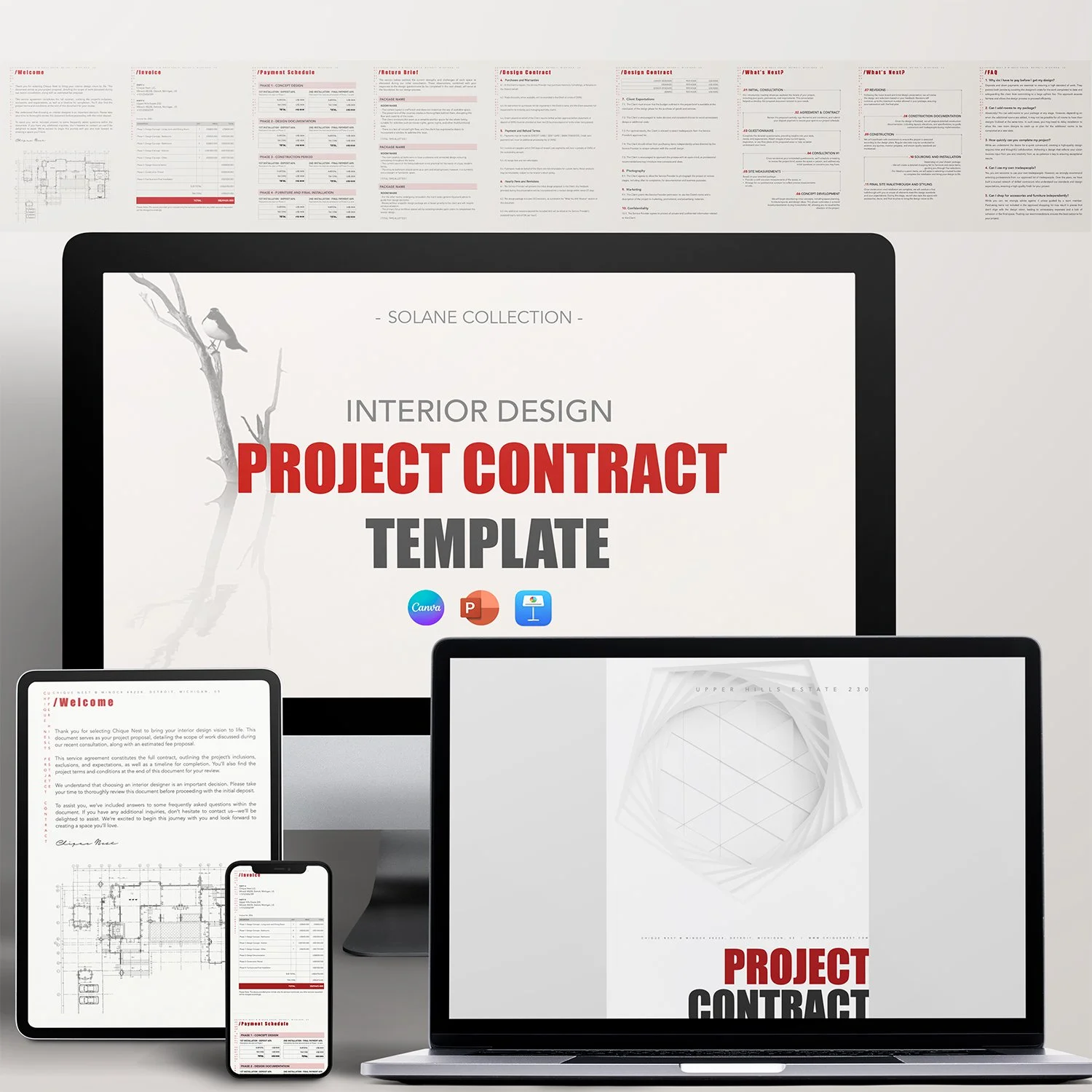
The clearest way to communicate a design decision is with a presentation that looks and feels considered. Chique Nest's client presentation and proposal templates give your ideas the professional visual context that helps any client — regardless of their design literacy — say yes with confidence.

Stop sending clients a plain PDF and hoping it lands. The Chique Nest Project Proposal Template gives you a beautifully laid-out proposal that shares your inspiration, goals, requirements, mood board, and timeline — everything a client needs to say yes.
Tells the Full Design Story: From inspiration and design goals through to project requirements and mood board, clients see your thinking, not just your pricing.
Fully Customizable: Easily tailor fonts, colors, images, and layouts in Canva, PowerPoint, or Keynote to reflect your brand's unique identity.
Visual Project Timeline: A clean 5-phase timeline graphic so clients know exactly what to expect and when.
Past Work Built In: Dedicated "Our Works" pages with room to showcase real projects and client testimonials.
Save Time and Effort: Stop rebuilding a proposal deck from scratch for every new lead — just update the project details.
—— 📨 What’s Included in the download?
You’ll receive:
✅ 5 Files Total
• PDF with Download Link + Instruction Manual
• 1 Keynote Template
• 1 PowerPoint Template
• 1 Canva Template
• 1 PDF Example File by Chique Nest
✅ 17 Fully Editable Pages
—— 🖌️ What’s inside the template?
This comprehensive project proposal includes every section you need to pitch and win a new project:
✔️ Welcome
✔️ Finding Inspiration
✔️ Design Goals
✔️ Project Requirements
✔️ Mood Board
✔️ Project Timeline
✔️ Terms
✔️ Design Process
✔️ Next Steps
✔️ Our Works
✔️ Meet Our Team
✔️ Contact Us
—— 📂 File Format & Compatibility:
Available in Widescreen (16:9) format, this template is compatible with:
✔️ Canva (requires a free Canva account)
✔️ PowerPoint
✔️ Keynote
All elements are fully customizable, including fonts, text, images, and branding.